
A homeowner calls about a ceiling stain near the chimney. The shingles look perfect from the driveway, and the roof is only eight years old. Nothing about it looks like a roof problem.
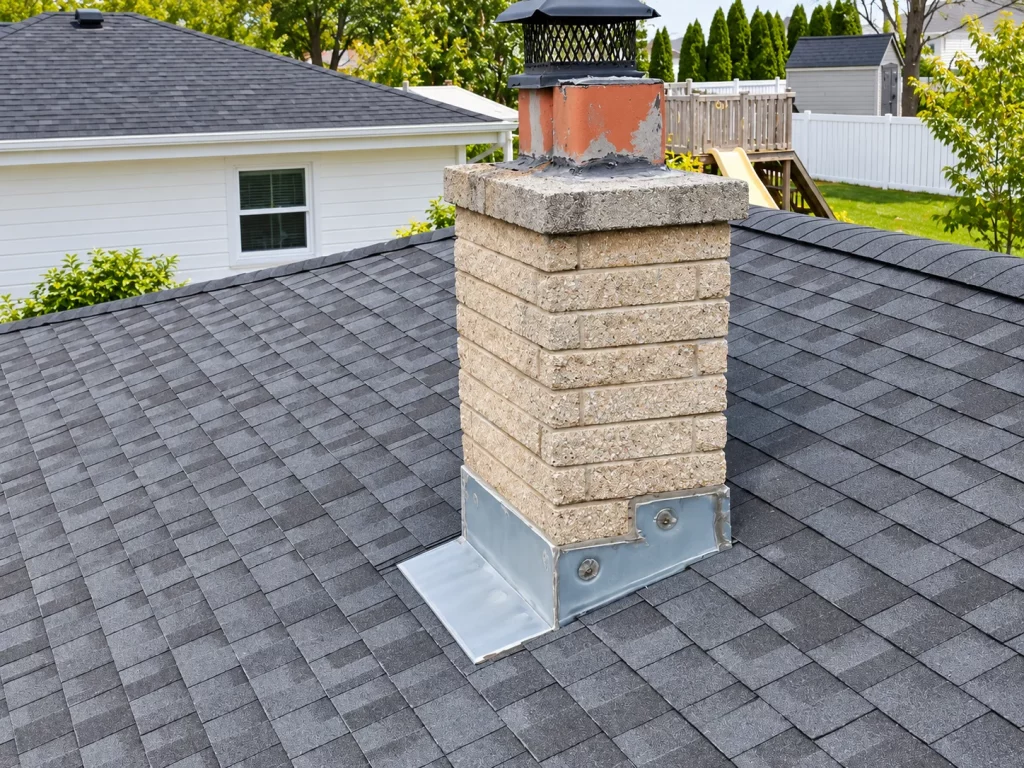
It usually is not the shingles. It’s the roof flashing, the metal that seals every joint where the roof meets something else.
Flashing is the first thing to fail on most roofs and the cause behind a large share of roof leaks. It’s also the part almost nobody thinks about until water is already inside.
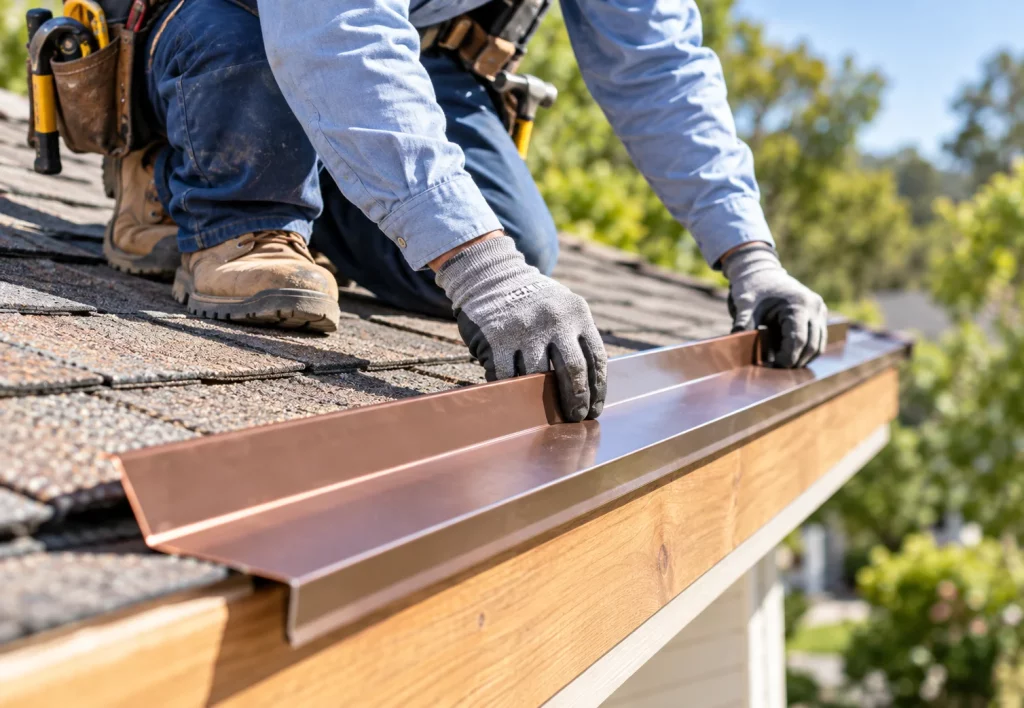
Roof flashing is thin corrosion-resistant metal installed at every point where the roof surface meets a wall, a chimney, a skylight, a pipe, or another roof plane.
Shingles handle water on open slopes. They cannot seal a joint. Anywhere the roof plane stops or changes direction, there is a seam, and a seam without flashing is an opening.
The job is not to block water. It’s to catch water and redirect it back onto the shingle surface so it keeps running downhill and off the roof. Good flashing works by layering and gravity rather than by sealant.
That distinction matters more than anything else in this article. Flashing that relies on caulk to stay watertight is flashing installed wrong.
Most houses have more flashing than the owner realizes. Each of these is a separate potential leak point.
Kickout flashing is the one most often missing entirely. When it is absent, water runs down inside the wall for years before anyone sees a stain, and the repair becomes a siding and framing job rather than a roofing one.
In roughly the order we see it.
That last point deserves its own paragraph. On a tear-off, removing and replacing chimney and wall flashing takes time and costs money, so some crews leave the old flashing in place and seal around it. The shingles are new. The leak point is not. When a roof that was replaced two years ago starts leaking at the chimney, this is almost always why.
Ask any roofer quoting a replacement whether flashing replacement is included in the price or listed as an option. The answer tells you a lot.
You can narrow this down without getting on the roof. Stay on the ground and in the attic.
Signs that point to flashing rather than shingles include the following.
One timing clue is worth knowing. A flashing leak frequently only appears during wind-driven rain, when water is pushed sideways and upward under the metal rather than running straight down. If your leak shows up in storms but not in ordinary rain, flashing is the first suspect.
Check the attic with a flashlight while standing on solid flooring or a joist. Staining on the decking near a chimney or wall confirms it quickly. Leave the roof surface itself to someone with fall protection and training.
Step flashing is the method used where a roof slope runs alongside a vertical wall, and it’s the type most often done wrong.
Instead of one long strip, step flashing uses individual L-shaped pieces woven in with each course of shingles. Every piece overlaps the one below it, so water landing on the wall gets stepped down the slope and back out onto the shingles.
The code requirement is specific. For asphalt shingle roofs, base flashing against a vertical sidewall must be continuous or step flashing, at least 4 inches in height and 4 inches in width, and it must direct water away from the wall onto the roof or into the gutter. The vertical leg has to run continuously under the siding, not on top of it.
Here is the shortcut to watch for. A single continuous strip of metal caulked against the siding is faster to install and looks fine from the ground. Water that gets behind it has nowhere to step back out, so it runs down inside the wall instead.
If you can see flashing sitting on top of the siding rather than tucked behind it, that’s a problem regardless of how fresh the caulk looks.
Metal flashing comes in a few standard choices, and the right one depends on the location and the wall material.
| Material | Strengths | Watch out for |
|---|---|---|
| Galvanized steel | Most common, strong, affordable | Rusts over time, especially in humid conditions |
| Aluminum | Light, will not rust, easy to form | Corrodes in direct contact with masonry or mortar |
| Copper | Longest lasting, solders into a sealed joint | Highest cost, patinas green |
| Lead | Forms tightly around irregular shapes | Mainly used on boots and specialty details |
Code requires flashing metal to be corrosion-resistant and of an approved thickness, which rules out the thin stock sold for gutters and general sheet metal work.
For a Louisiana chimney, the aluminum and masonry issue is the one to flag. Aluminum in direct contact with wet mortar corrodes faster than most homeowners expect.
Both are legitimate depending on the condition.
Repair makes sense when the metal itself is sound and only the counterflashing seal at the masonry has failed, or when a single pipe boot has cracked while everything else is intact. Resealing a reglet joint on good copper or steel is a real fix, not a bandaid.
Replacement makes sense when the metal is rusted through, when it was installed incorrectly in the first place, or when you’re already tearing off the shingles. Roof flashing repair done over a bad installation buys months, not years.
The honest test is whether the water path is correct. If the layering is wrong, no amount of sealant fixes it, because you’re asking caulk to do a job that gravity and overlap are supposed to do.
During a full roof replacement, flashing should be replaced as a matter of course, with the possible exception of copper in good condition.
Copper can outlast several shingle layers. Galvanized steel and aluminum generally fall somewhere in the range of an architectural shingle’s service life, meaning flashing and shingles often reach the end together.
The practical rule is that flashing rarely survives two roofs. A roof that has been replaced once with the original flashing left in place is carrying metal that’s twice the age of its shingles.
If your roof has been replaced before and you do not know whether the flashing was replaced with it, that’s worth finding out before the next storm season rather than after.
Caulk is a supplement, not a flashing method. It can buy time on a sound piece of metal with a failed seal, but it cannot fix flashing that was layered incorrectly. Sealant applied over a bad installation typically fails again within a year or two.
In most cases yes. Reusing old flashing under new shingles is a common source of leaks on roofs that are only a year or two old. Ask whether flashing replacement is included in the quote or listed separately.
That pattern usually points to flashing rather than shingles. Wind-driven rain gets pushed sideways and upward under metal that sheds ordinary rainfall fine, so the leak appears only when the wind is behind the water.
Step flashing uses individual pieces woven in with each shingle course, so water gets stepped back out onto the roof. Continuous flashing is a single strip. Both are allowed by code, but a continuous strip sealed on top of siding rather than tucked behind it is a leak waiting to happen.
Storm damage to flashing is generally treated like other wind or hail damage and may be covered, subject to your deductible. Failure from age, corrosion, or bad installation is normally not covered, since insurers treat that as maintenance.
Kickout flashing sits at the bottom of a roof-to-wall run and diverts water into the gutter instead of behind the siding. It’s frequently missing on older homes, and its absence causes wall and framing damage that stays hidden for years.
Schedule a free roof inspection with JosephMill. We will trace the leak to its source, check the chimney, wall, and skylight flashing that shingle inspections skip, and tell you plainly whether you’re looking at a repair or a replacement. Call (225) 500-1444 or request an inspection.