Mansard Roof Repair and Replacement in Denham Springs, Louisiana

The mansard roof is one of the most architecturally distinctive and technically demanding residential roof styles found throughout Denham Springs and Livingston Parish. JosephMill provides licensed mansard roof repair, replacement, and storm damage restoration built around the near-vertical slope installation requirements, dormer intersection complexity, and Louisiana climate conditions that determine how a mansard roof actually performs over time.

Get In Touch

The Mansard Roof, French Architecture, Louisiana History, and Modern Challenges

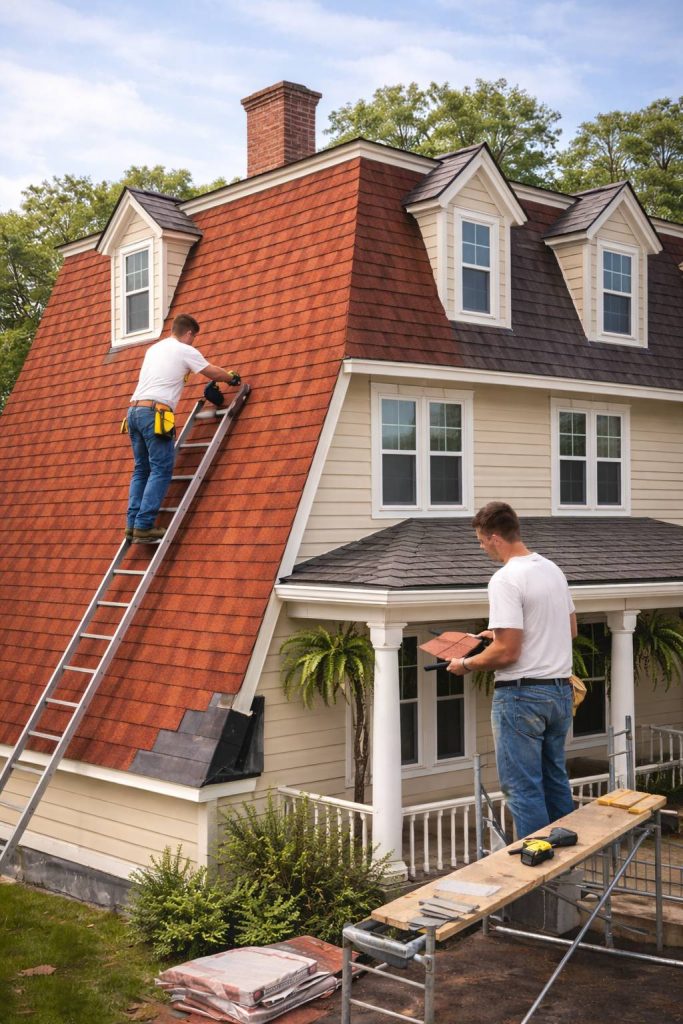
A mansard roof has four sides, each with two slopes, a nearly vertical lower slope that rises steeply from the eave line and a shallow upper slope that meets at a flat or nearly flat deck at the top of the structure. The design takes its name from seventeenth-century French architect François Mansart and spread through Louisiana’s architectural vocabulary during the French colonial and Creole revival periods that shaped much of the residential building stock throughout Livingston Parish, the greater Baton Rouge area, and South Louisiana generally.

The mansard roof’s defining practical advantage is the same as the gambrel’s, maximizing interior living space under the roof structure. Where a standard sloped roof compresses interior volume as the ceiling follows the pitch inward, a mansard roof’s steep lower slopes push the full ceiling height outward to the wall line, effectively creating a full additional story within the roof envelope. This is why mansard roofs appear throughout older Denham Springs neighborhoods on two-story homes where the upper floor lives entirely within the mansard structure.

The architectural result is one of the most visually prominent roof profiles in residential construction. The near-vertical lower slopes are the dominant exterior feature of a mansard-roofed home, visible from every approach, defining the home’s character, and comprising a significantly larger roofing surface area than the shallow upper deck above them. This visibility and surface area creates roofing challenges that are unique to the mansard style and that require a contractor with specific knowledge of how this roof behaves in Louisiana’s climate.

The Specific Vulnerabilities of a Mansard Roof in Louisiana's Climate

The Near-Vertical Lower Slope, When a Roof Behaves Like a Wall

The Near-Vertical Lower Slope, When a Roof Behaves Like a Wall

The lower slope of a mansard roof is its defining feature and its most technically demanding roofing surface. At pitches ranging from 70 to 85 degrees from horizontal, sometimes steeper, the mansard lower slope is not a conventional roof surface in any meaningful installation sense. It is closer to a vertical wall that happens to be covered with roofing material rather than siding.

First, drainage. On a conventional roof pitch water flows down the slope by gravity and exits at the eave. On a near-vertical mansard slope water does not flow, it sheets. The velocity of water sheeting down a near-vertical surface is significantly higher than water flowing down a standard pitch, and the force of that sheeting water acts against every shingle edge, every flashing lap, and every penetration seal on the lower slope simultaneously during a Louisiana rainfall event. Standard shingle installation at the overlap and fastening dimensions designed for conventional pitches do not adequately resist the penetration force of high-velocity sheeting water on a near-vertical surface.

Second, fastening. Shingles installed on a near-vertical surface are subject to gravity-driven downward pull in addition to wind uplift forces. On a conventional pitch gravity acts perpendicular to the roof surface, pressing the shingle into the deck. On a near-vertical pitch gravity acts nearly parallel to the surface, pulling the shingle downward along the face of the roof. Fasteners that are adequate to resist perpendicular uplift may not be adequate to resist the combination of perpendicular uplift and parallel downward pull simultaneously. On a Denham Springs mansard roof in Louisiana’s wind environment this combined loading is a real and recurring failure mechanism.

Third, wind pressure. Louisiana’s hurricane and tropical storm winds act against the near-vertical lower slope of a mansard roof with the same force they act against an exterior wall because, for all practical aerodynamic purposes, that is what the lower slope is. Direct wind pressure against the full face of the lower slope creates uplift at the shingle edges and inward pressure against the sheathing and framing simultaneously. This is a wind loading condition that is more analogous to wall cladding performance than conventional roof shingle performance, and it should be evaluated as such in every mansard roof installation and inspection.

Shingle Selection and Installation on Near-Vertical Mansard Slopes

Shingle Selection and Installation on Near-Vertical Mansard Slopes

Standard architectural shingles have a manufacturer-recommended maximum pitch above which their installation requires specific modifications. At very steep pitches, above approximately 21:12, which is close to but not yet at mansard slope angles, shingles require hand-sealing of each tab or shingle edge with roofing cement in addition to standard fastening. This is necessary because the sealant strips that normally bond shingle to shingle by solar heat activation cannot generate sufficient adhesion on near-vertical surfaces where the shingles face away from direct solar exposure for most of the day.

On a mansard lower slope at 70 to 85 degrees from horizontal every shingle requires individual hand-sealing at installation. This is a labor-intensive installation step that cannot be skipped on Louisiana mansard roofs. Without hand-sealing the sealant strips between courses never fully activate, shingles remain individually unfastened to each other above the nail line, and wind events, particularly the sustained high winds of a Louisiana hurricane or tropical storm, progressively lift and strip the mansard lower slope from the bottom up as each course separates from the one above it.

This is the failure mode that produces the dramatic visual result of a mansard roof lower slope partially or fully stripped of shingles after a hurricane event in Livingston Parish, and it originates not at the storm itself but at the installation that skipped hand-sealing.

The Upper Slope Transition, Where Mansard Meets Flat

The Upper Slope Transition, Where Mansard Meets Flat

The upper section of a mansard roof, the shallow deck that crowns the structure, is functionally a low-slope or flat roof. The pitch of the mansard upper deck typically falls below the minimum reliable slope for standard shingle installation, often 1:12 to 2:12, placing it squarely in the category of flat roof waterproofing rather than sloped roof waterproofing.

The transition from the near-vertical lower slope to the nearly flat upper deck is the most complex single waterproofing detail on a mansard roof. Water sheeting down the near-vertical lower slope at high velocity approaches the eave of the upper deck and must be redirected onto the flat deck surface without being driven up and under the flat deck membrane by the velocity and pressure of the flow coming off the lower slope below it.

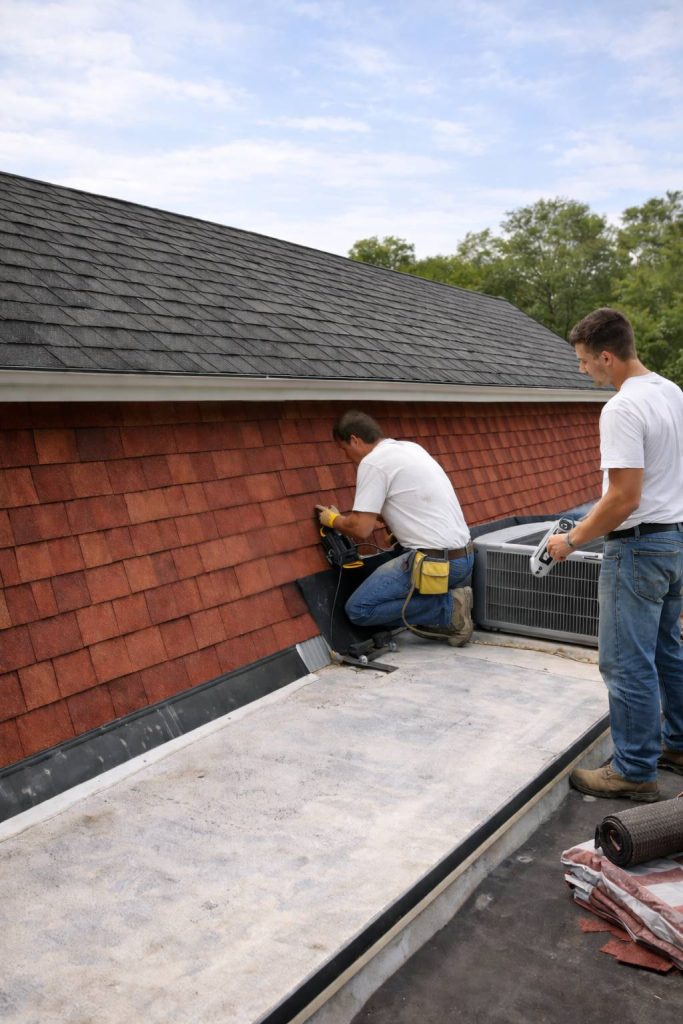
This transition requires a specific flashing detail, a continuous metal counterflashing that caps the top edge of the lower slope shingles, extends horizontally onto the flat deck surface, and integrates with the flat deck waterproofing membrane below. The counterflashing must be tall enough to prevent wind-driven water from topping it during Louisiana storm events, correctly lapped with both the lower slope underlayment below and the flat deck membrane above, and sealed at every joint and penetration point along its length.

In Louisiana’s wind environment, where hurricane-force winds can drive water upward against gravity, the height and sealing of the counterflashing at the lower slope to upper deck transition is the single most critical storm performance detail on the entire mansard roof assembly.


Dormer Intersections, Complexity Concentrated at Multiple Points

Dormer Intersections, Complexity Concentrated at Multiple Points

Mansard roofs in Denham Springs frequently incorporate dormers, window structures that project through the lower slope face of the mansard to provide light and ventilation to the upper floor living space within the mansard envelope. Dormers on a mansard roof create multiple waterproofing complexity points simultaneously. The dormer sides intersect the near-vertical lower slope creating vertical-to-vertical flashing details. The dormer top intersects the lower slope above the dormer, requiring a saddle or cricket flashing to redirect water around the dormer projection. The dormer base intersects the lower slope below the dormer, requiring step flashing and kickout flashing to direct water away from the dormer-to-slope junction.

Each of these intersections on a mansard dormer is more demanding than the equivalent intersection on a conventional slope because the near-vertical lower slope geometry creates flashing conditions that differ from standard pitch detailing at every point. The vertical-to-vertical flashing at the dormer sides, where a near-vertical wall intersects a near-vertical roof slope, requires a counterflashing approach similar to what is used at parapet walls on flat roofs rather than the standard step flashing used at dormer sides on conventional pitched roofs.

On Denham Springs mansard roofs with multiple dormers each dormer represents a cluster of three to four high-priority waterproofing intersections. A mansard roof with four dormers has twelve to sixteen complex flashing details that must all be correctly executed and maintained. This is why mansard roof inspections in Livingston Parish require significantly more time and more detailed documentation than gable or hip roof inspections of comparable square footage.

Louisiana Heat and the Near-Vertical South Face

Louisiana Heat and the Near-Vertical South Face

The south-facing lower slope of a Denham Springs mansard roof receives near-perpendicular solar radiation for a significant portion of each day during Louisiana’s long, intense summer season. A near-vertical surface oriented south receives solar radiation at a much higher angle of incidence than a standard roof pitch. The sun’s position in Louisiana’s summer sky means a near-vertical south face is essentially in direct broadside exposure to solar radiation during midday hours.

This creates accelerated UV degradation and thermal cycling on the south-facing mansard lower slope compared to the north, east, and west faces. Shingle granule loss, asphalt binder breakdown, and sealant degradation all progress faster on the south face than on the other three faces. In a Louisiana climate where these degradation mechanisms already operate faster than in moderate climates, the south face of a mansard lower slope is the first surface to reach end-of-service-life condition, often years before the other three faces.

This asymmetric degradation pattern is important for Denham Springs mansard roof inspection and replacement planning. A uniform four-face replacement on a schedule driven by the worst face’s condition may replace three faces that have significant remaining service life. An inspection approach that assesses each face individually and tracks differential degradation rates gives a more accurate picture of the roof’s actual condition and a more cost-effective planning basis for replacement.

TESTIMONIALS

What they say about us.

JosephMill, LLC place picture
5.0
Based on 97 reviews
powered by Google
Crystal Marchand profile picture
Crystal Marchand
22:47 06 Nov 25
Justin took great care of us. Our roof looks great!
Becky Evans profile picture
Becky Evans
19:17 27 Oct 25
I had such a great experience with this roofing company! From start to finish, everything was handled smoothly and professionally. Alec Joubert was outstanding — professional, kind, and on top of every detail. He made sure everything was taken care of and kept me informed throughout the whole process. It’s refreshing to work with someone who truly cares about their customers and takes pride in their work. Highly recommend this company and definitely ask for Alec!
Photo from customer review
Sandy Garver profile picture
Sandy Garver
21:07 16 Sep 25
Use this company to get your new roof! Everyone was so very helpful and responsive throughout the entire process, especially Justin and Scott! From start to finish, Scott saw our project through and helped us get insurance to cover our new roof. Scott was very patient with all my questions and concerns, and always found an answer for me if he didn't know it already. Jorge and his crew were amazing as well when it came time to install the new roof. Jorge kept me informed as the day progressed and even went out of his way to fix another issue in my attic that was unrelated to the roof itself, just out of the kindness of his heart! Great company with great employees who treat you like family. You won't regret using them!
Response from the owner 16:43 17 Sep 25
Thank you so much for the incredible feedback! We’re thrilled that Justin, Scott, and Jorge made the entire process smooth and stress-free for you. Scott’s attention to detail and Jorge’s extra effort in your attic show exactly how we aim to treat every homeowner—like family. We appreciate you trusting JosephMill with your home and your new roof. Enjoy the peace of mind that comes with it, and thank you for recommending us!—The JosephMill Team
Brett Varnell profile picture
Brett Varnell
23:19 28 Jul 25
They made the process very easy. Located in Jefferson Terrace. Alec/Drew handled the project and Insurance work. Installation was clean and efficient. Wouldn't hesitate to recommend.
Response from the owner 16:26 30 Jul 25
Appreciate the great review! Alec and Drew always aim to make the process smooth and stress-free. Glad everything went clean and efficient—thanks for trusting us and for the recommendation!
andrea ordoyne profile picture
andrea ordoyne
17:46 27 Jul 25
Awesome to work with! Very professional and did a fantastic job. Also helped us with other things we needed to take care of around our house. Highly recommend!
Response from the owner 16:23 30 Jul 25
Thanks for the 5 stars! Justin takes pride in going above and beyond—glad he knocked it out for you. We appreciate the trust and the kind words!
Kelli Doucet profile picture
Kelli Doucet
18:52 24 Jul 25
Gaige Duplechin was so helpful and took care of everything. Would recommend Joseph Mill roofing everytime!
Response from the owner 19:36 24 Jul 25
Thank you so much, Kelli! We’re glad to hear Gaige took great care of you—he’s a key part of our team and always goes the extra mile. We truly appreciate your recommendation and look forward to helping with any future roofing needs!—The JosephMill Team
Greg Brown profile picture
Greg Brown
15:41 30 Jun 25
Scot Beatty at Joseph Mills was amazing from start to finish. Not only did the tarp on my roof make it through the hurricane he walked me through the nightmare that is home owner’s insurance. Thank you Scot and Joseph Mills!
Response from the owner 14:55 03 Jul 25
We really appreciate the time it takes for you to leave us a review. We also love hearing the testimonies of homeowners who got a win! Thanks for trusting us with your home.
Taylor Landry profile picture
Taylor Landry
13:57 13 Jun 25
Cold Calling everyone in the neighborhood of Magnolia Woods about roofing work. They called my wife's cell (a memphis number) and were asking/looking for me. My wife said it is the wrong number, and they insisted that number was actually my number. Again my wife said NO it is not, and asked how they got her cell number and they again asked for me by name and cited that they know this is my number because they got it off "some list". Desperate company, I would never use. If someone has roofing issues, they will obviously reach out to a roofing company - we do not need to be SPAMMED about it.
Response from the owner 14:59 13 Jun 25
Thanks for your feedback, and I’m sorry for the negative experience you and your wife had. That’s absolutely not the way we want to show up in the community.We train our team to be respectful and professional at all times—especially when reaching out to local homeowners. Based on your note, it sounds like we missed the mark here. We’ll be reviewing this call and tightening up our outreach process immediately.For what it’s worth, we aren’t “spamming”—we’re a local company trying to make people aware of storm damage and insurance benefits they often don’t know about. That said, it should never feel pushy or invasive.If you’d be open to a quick call, I’d like to personally apologize and make it right. Either way, we appreciate your time and take your words seriously.— Chad Elrod, CSO📞 225.400.1009 | 📧 Chad@josephmill.com
Catherine Verrett profile picture
Catherine Verrett
16:54 22 May 25
A truly great experience with the company. Alec Joubert was our contact person/salesman. He kept us informed every step of the way. We highly recommend JosephMill.
You will not be disappointed ⭐️⭐️⭐️⭐️⭐️
Response from the owner 15:03 05 Jun 25
We love hearing about great experiences. Thank you for your business and taking the time to leave us a review. The whole JM team appreciates you.

Mansard Roof Services in Denham Springs, Louisiana

Mansard Roof Inspection in Denham Springs

Every JosephMill mansard roof inspection in Denham Springs covers all four lower slope faces with specific attention to shingle hand-seal condition and fastening integrity on each face, the upper deck waterproofing membrane and drainage condition, the full lower slope to upper deck counterflashing detail, all dormer intersections, sides, tops, and bases, on every dormer present, all penetrations on both the lower slopes and upper deck, and the differential condition assessment across all four faces.

Mansard roof inspections cannot be completed from ladder height at the eave. The upper deck requires access and direct inspection. It is a flat roof system that must be walked and assessed the same way any flat or low-slope roof is inspected. We do not complete a mansard inspection without accessing the upper deck.

Free mansard roof inspections throughout Denham Springs and Livingston Parish.
Call to schedule: (225) 500-1444.

Mansard Roof Repair in Denham Springs

Mansard roof repairs in Denham Springs concentrate at three locations, lower slope shingle failure from missing hand-seal or wind uplift, dormer intersection flashing failures on one or more of the three flashing details at each dormer, and upper deck membrane failures or counterflashing separation at the lower slope to upper deck transition.

We identify the specific failure mechanism at each location before writing any repair scope. A mansard lower slope that has lost shingles after a wind event may have lost them because the hand-seal was never applied, because the fastening pattern was inadequate for the near-vertical pitch and wind loading, or because the shingles were past their service life on that face, three different root causes with different repair approaches and different implications for the remaining three faces.

Common mansard roof repairs we perform throughout Denham Springs and Livingston Parish include lower slope shingle replacement with correct hand-sealing on all replaced courses, dormer side flashing and counterflashing repair or replacement, dormer saddle and kickout flashing repair, counterflashing repair or replacement at the lower slope to upper deck transition, upper deck membrane repair for punctures, splits, or lap failures, and penetration seal replacement on both lower slopes and upper deck.

Mansard Roof Replacement in Denham Springs

When a Denham Springs mansard roof requires full replacement, JosephMill performs a complete system installation that addresses every specification unique to this roof style. This includes hand-sealing of every shingle course on all four lower slope faces, the correct fastening pattern for near-vertical pitch with combined uplift and downward pull loading, full counterflashing installation at the lower slope to upper deck transition with the correct height and lap sequence, dormer intersection flashing at all three detail points on every dormer, and upper deck membrane replacement with proper drainage provisions.

Full tear-off is performed on every mansard roof replacement in Denham Springs, both the lower slope shingles and the upper deck membrane. With the lower slope sheathing exposed we inspect every face for moisture damage, fastener pullout evidence from previous wind events, and sheathing integrity that must be confirmed before new material is installed. With the upper deck membrane removed we inspect the deck substrate for ponding water damage, membrane adhesive deterioration, and insulation condition where applicable.

Mansard Roof Storm Damage Restoration in Denham Springs

Storm damage on a Denham Springs mansard roof after a Louisiana hurricane or tropical storm concentrates on the lower slope faces, particularly the south and southwest faces that take direct wind exposure during Gulf storm tracks, and at the dormer intersections where wind-driven water finds the flashing details most vulnerable to pressure infiltration.

We document storm damage on all four lower slope faces independently, the upper deck condition, and every dormer intersection during every Denham Springs mansard roof storm damage inspection. Differential damage between faces is common after directional storm events. The face directly opposing the storm track sustains different damage than the faces perpendicular to it — and our documentation reflects each face’s actual condition independently rather than applying a uniform four-face assessment.

Mansard Roof Emergency Repair in Denham Springs

When a storm has damaged your Denham Springs mansard roof — lower slope shingle loss, dormer flashing failure, or upper deck membrane breach — call JosephMill directly. We will get someone out to assess and protect your home as quickly as possible throughout Livingston Parish.

Roofing Materials We Install on Denham Springs Mansard Roofs

A mansard roof requires material specifications for two fundamentally different roof systems on the same structure, a steep-slope shingle system on the lower slopes and a low-slope membrane system on the upper deck. Each system has its own material requirements, and neither can substitute for the other.

Lower Slope Shingles, Weight, Wind Rating, and Hand-Seal Compatibility

Shingle selection for a mansard lower slope in Louisiana should prioritize wind resistance rating, shingle weight, and compatibility with hand-sealing at steep pitches. Heavier shingle products resist the combined gravity and wind uplift loading on near-vertical surfaces better than lighter products. High wind resistance ratings, 130 mph or higher, are relevant to the direct wind pressure load the lower slope faces in Louisiana’s storm environment. Impact resistance ratings are also relevant to the hail exposure all four faces receive.

Atlas offers impact-rated architectural shingle lines with the wind resistance specifications appropriate for Louisiana mansard lower slope conditions. We discuss the specific product options for your home during the inspection and estimate.

Upper Deck Membrane, Flat Roof Waterproofing for Louisiana Conditions

The mansard upper deck requires a low-slope or flat roof waterproofing membrane — not shingles. The appropriate membrane specification depends on the deck slope, existing substrate condition, drainage configuration, and whether the deck is accessible or non-accessible. We assess the upper deck specifically during every mansard roof inspection and estimate the membrane replacement as a separate scope from the lower slope shingle work.

Metal Roofing on Mansard Lower Slopes

Standing seam metal roofing is a historically appropriate and technically superior material option for mansard lower slopes in Louisiana. The standing seam profile, with concealed fasteners and continuous panel runs from the upper deck transition to the eave, eliminates the fastening and hand-seal requirements of shingle installation on near-vertical surfaces. Panel-to-panel seams are mechanically locked rather than adhesively bonded, providing wind resistance that is not dependent on sealant activation or hand-applied cement.

For Denham Springs mansard roofs where the lower slope shingle system has experienced recurring wind damage, or where the homeowner wants a material that matches the near-vertical surface’s performance demands more directly, standing seam metal is worth a specific conversation during the estimate process.

What to Expect After a Mansard Roof Storm Event in Denham Springs

After any storm event that affects your Denham Springs mansard roof, JosephMill documents storm damage on all four lower slope faces independently, the upper deck condition, and every dormer intersection — with photos and written notes before any repair work begins. You receive a clear itemized estimate with any signed contract before any work is started. Your dedicated project manager will walk you through your options and timeline from inspection to completion.

What to Expect After a Mansard Roof Storm Event in Denham Springs
Mansard Roof Services Throughout Denham Springs and Livingston Parish

Mansard Roof Services Throughout Denham Springs and Livingston Parish

From our Denham Springs office we inspect, repair, and replace mansard roofs throughout Livingston Parish and East Baton Rouge Parish.

Frequently Asked Questions

Why does my mansard roof keep losing shingles on the lower slope in storms?

Recurring lower slope shingle loss after wind events on a Denham Springs mansard roof almost always traces back to one of two root causes. The first is missing hand-sealing — shingles on near-vertical mansard slopes must be individually hand-sealed with roofing cement at installation because the standard sealant strip between courses cannot thermally activate on a surface that faces away from direct solar exposure. Without hand-sealing the courses above the fastener line are individually unsecured and lift progressively in wind events. The second is inadequate fastening — the near-vertical pitch creates a combined gravity and wind uplift loading condition that requires more fasteners per shingle than standard pitch installation. If both of these specifications were not addressed when the roof was last installed or repaired — the lower slope will continue losing shingles at every significant wind event regardless of shingle brand.

Yes — the lower slopes and upper deck are separate roofing systems and can be addressed independently when the condition of each warrants it. If the lower slope shingles have reached end of service life or sustained storm damage but the upper deck membrane is in good condition with adequate remaining life — replacing the lower slopes without disturbing the upper deck is the appropriate scope. Conversely if the upper deck membrane has failed but the lower slope shingles are sound — the deck can be re-membraned without disturbing the lower slopes. We assess both systems independently during every mansard roof inspection and present options that reflect the actual condition of each system.

Yes — dormers on a mansard lower slope are the highest-maintenance detail on the entire roof assembly. Each dormer creates three complex flashing intersections — the dormer sides where a near-vertical wall meets a near-vertical roof slope, the dormer top where a saddle or cricket directs water around the dormer projection, and the dormer base where kickout flashing prevents water from running behind the lower slope shingles at the dormer foot. In Louisiana’s rainfall and wind environment all three intersections are under sustained stress during every storm event. We recommend inspecting all dormer flashing intersections after every significant storm event — not just during annual inspections — because dormer flashing failures in Louisiana progress quickly from minor separation to active water intrusion.
For Denham Springs homeowners whose primary concern is wind resistance and long-term performance on the lower slopes — yes. Standing seam metal eliminates the hand-sealing requirement, provides mechanically locked seam-to-seam connections that do not rely on adhesive activation, and handles the combined gravity and wind uplift loading of the near-vertical slope better than shingle systems whose performance depends on sealant chemistry and fastener pattern alone. The upfront cost is higher than shingles. The long-term performance case in Louisiana’s storm environment is strong — particularly for the south and southwest facing lower slopes that take the most direct wind and solar loading.

Yes — and it is a predictable consequence of Louisiana’s solar geometry. The south-facing lower slope of a mansard roof in Denham Springs receives near-perpendicular solar radiation during Louisiana’s long, intense summer season — essentially broadside solar exposure for significant portions of each day. UV degradation, granule loss, and sealant breakdown all progress faster on the south face than on the north, east, and west faces. It is entirely normal for a Denham Springs mansard roof to have a south face that is five to ten years further degraded in appearance than the other faces of the same age. We assess each face independently during inspection and can replace only the south face if the remaining three faces have adequate service life — there is no requirement to replace all four faces simultaneously if only one has reached end-of-life condition.

With correct installation — hand-sealing on all lower slope courses, adequate fastening for near-vertical pitch loading, correct counterflashing at the upper deck transition, and properly detailed dormer intersections — a mansard lower slope using impact-rated architectural shingles has a realistic service life of 20 to 25 years in Louisiana’s climate. Without correct installation the lower slopes typically begin failing within 10 to 15 years. The upper deck membrane has a separate service life depending on membrane type — typically 15 to 20 years for standard membrane systems in Louisiana’s heat and UV environment — the specific service life depends on the membrane type and coating condition at installation. The two systems almost never align in replacement timing — plan for the upper deck and lower slopes to be replaced on independent schedules based on their individual conditions.

Yes. JosephMill holds an active Louisiana Residential License — RL.886986 — and Commercial License — CL.77554 — both issued by the Louisiana State Licensing Board for Contractors and verifiable through the state board directly. William Stegall has personally installed and repaired roofs across Louisiana including mansard roof work throughout Livingston Parish and the greater Baton Rouge area where this roof style is common in the historic residential stock.