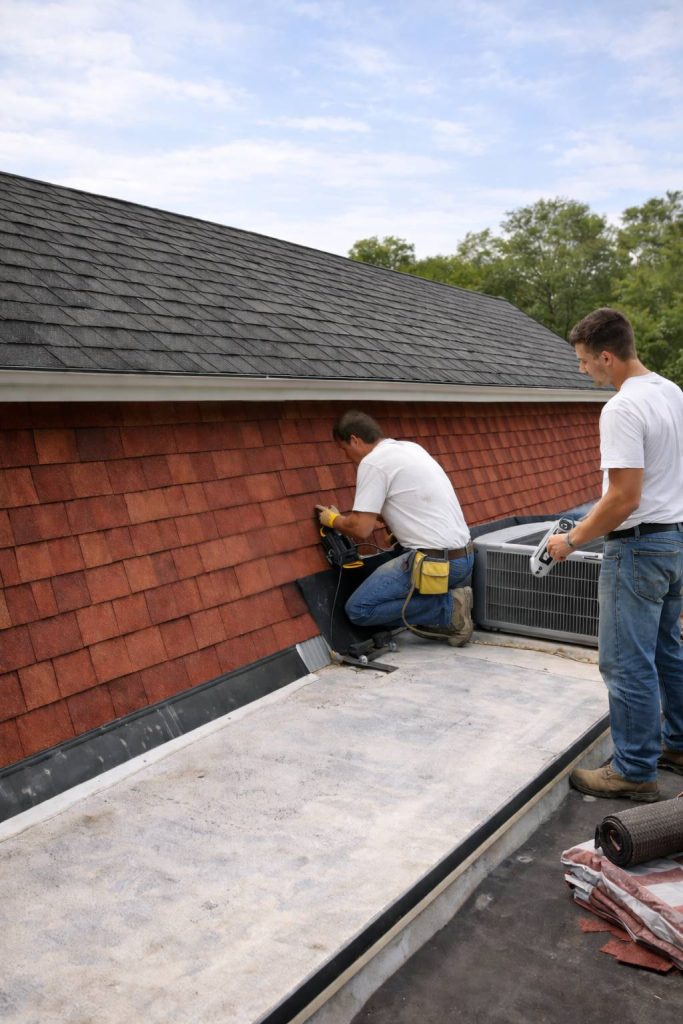
The upper section of a mansard roof, the shallow deck that crowns the structure, is functionally a low-slope or flat roof. The pitch of the mansard upper deck typically falls below the minimum reliable slope for standard shingle installation, often 1:12 to 2:12, placing it squarely in the category of flat roof waterproofing rather than sloped roof waterproofing.
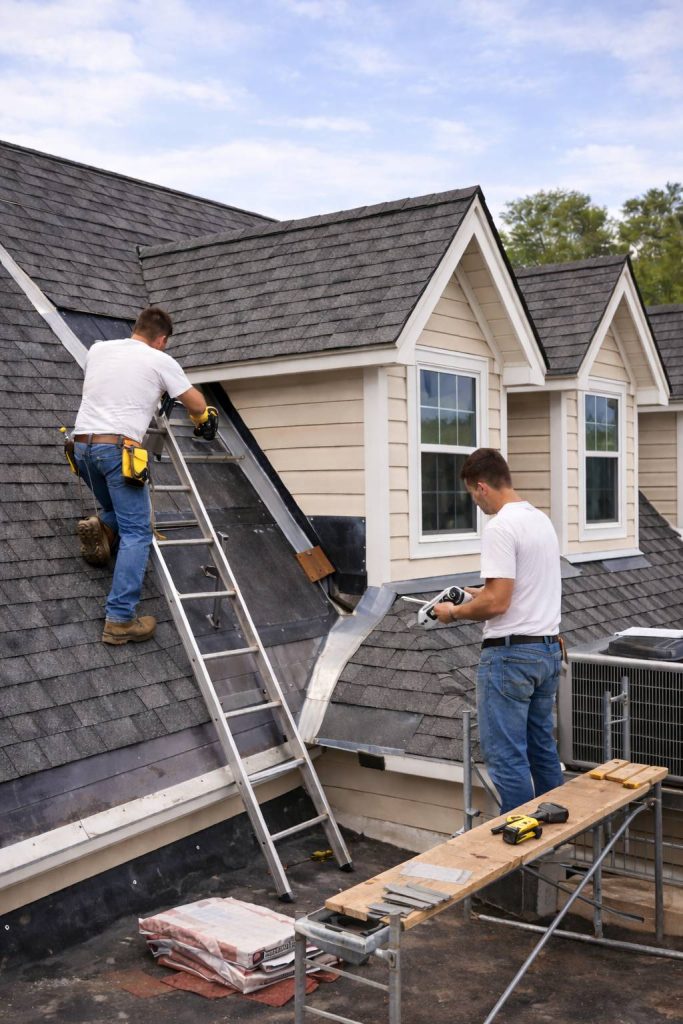
The transition from the near-vertical lower slope to the nearly flat upper deck is the most complex single waterproofing detail on a mansard roof. Water sheeting down the near-vertical lower slope at high velocity approaches the eave of the upper deck and must be redirected onto the flat deck surface without being driven up and under the flat deck membrane by the velocity and pressure of the flow coming off the lower slope below it.
This transition requires a specific flashing detail, a continuous metal counterflashing that caps the top edge of the lower slope shingles, extends horizontally onto the flat deck surface, and integrates with the flat deck waterproofing membrane below. The counterflashing must be tall enough to prevent wind-driven water from topping it during Louisiana storm events, correctly lapped with both the lower slope underlayment below and the flat deck membrane above, and sealed at every joint and penetration point along its length.
In Louisiana’s wind environment, where hurricane-force winds can drive water upward against gravity, the height and sealing of the counterflashing at the lower slope to upper deck transition is the single most critical storm performance detail on the entire mansard roof assembly.